Rental Reactor: Centralizing RV Rental Management
Overview
Travel trailer owners renting across multiple platforms like RVezy, RVShare, and Outdoorsy faced a fragmented, time-consuming workflow. Managing listings, tracking availability, and communicating with renters meant logging into each platform separately, manually updating calendars to avoid double bookings, and hunting for contact details that platforms deliberately kept obscured. For owners trying to grow a rental business on the side, the overhead was a barrier to scaling.
Rental Reactor was designed from the ground up to solve this. A centralized dashboard, unified messaging system, and an AI-powered agent that automatically scrapes and routes communications across platforms brought everything under one roof. This project spanned the full design process — from initial concept and wireframes through design system creation and front-end development — making it both a design challenge and a product-building experience.
Problem
RV and travel trailer owners renting across multiple platforms (RVezy, RVShare, Outdoorsy) struggled to manage listings, track availability, and handle communications. They had to manually log into each platform, update calendars separately (risking double bookings), track revenue in spreadsheets, and hunt for renter contact details obscured by platform policies. Communications came through different channels (email, text, in-platform messaging), making it difficult to respond quickly and maintain renter relationships.
Process
Started with user interviews identifying asset management and messaging as top priorities. Created user journeys for viewing, adding, editing, and archiving listings. Wireframed dashboard, listings page, and detail pages to communicate data requirements to the engineering team. Leveraged ShadCN/Tailwind design system for efficiency. Designed information architecture with "at-a-glance" listing cards and comprehensive detail pages. Created unified messaging interface with platform/type labels to consolidate communications. Iterated based on stakeholder feedback, adding features like communication labeling and AI status indicators. Handled both design and front-end development, allowing rapid experimentation.
Solution
Centralized dashboard showing revenue, occupancy, pending messages, active bookings, and fleet status. Listing management with cards displaying images, title, specs, ratings, current status (with guest/available/maintenance), and listing platform labels. Master calendar with color-coded view of all bookings and blackout dates across trailers. Unified messaging inbox with platform labels, listing context, and unread indicators. AI agent with approval-based reply system including thumbs up/edit feedback loop for training. Listing detail pages with rental history, financials, analytics, and credential management for third-party platforms. Status indicators (green/yellow/red) for AI scraping health. Global sidebar navigation throughout experience.
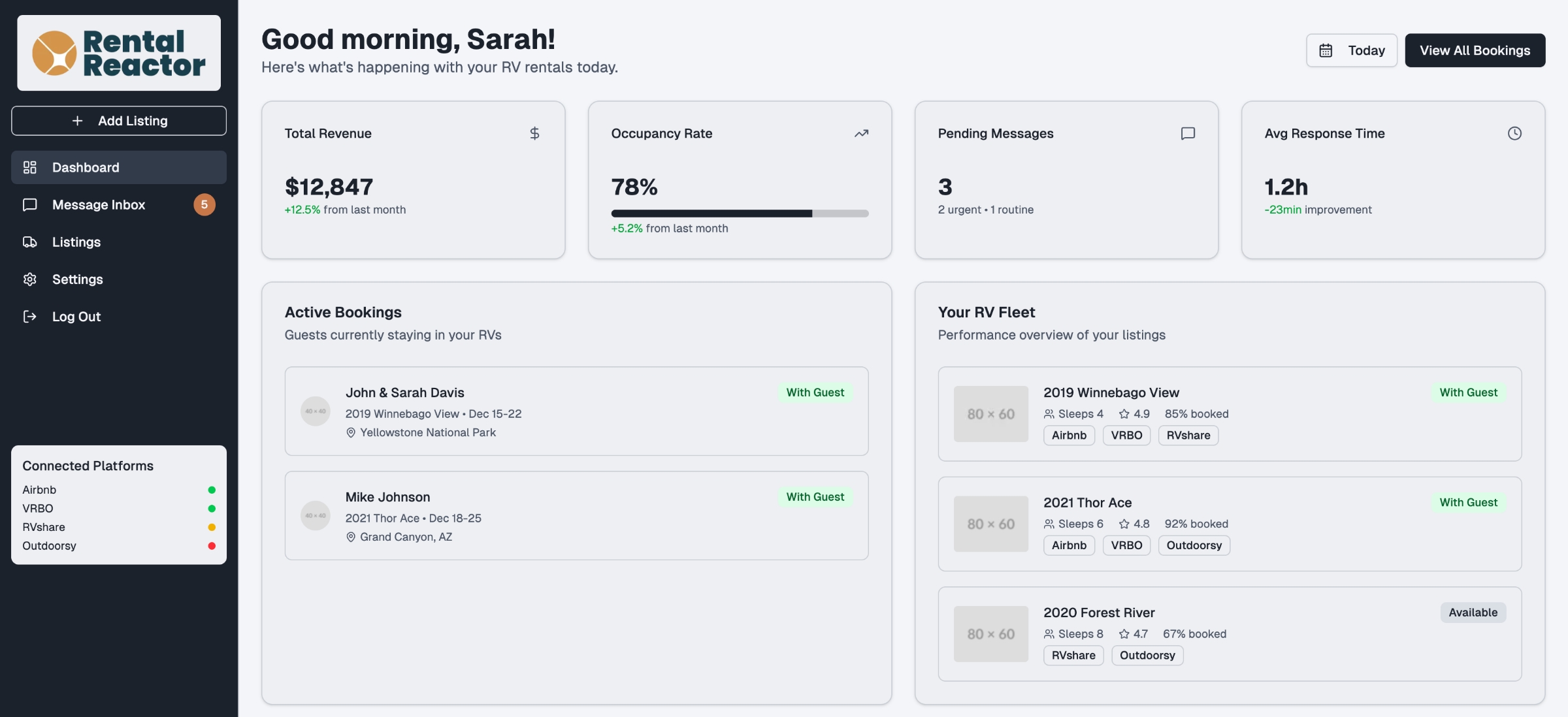
Rental Reactor's Dashboard shows the current state of your listings and booking status.
Outcome
Currently in development with beta launch planned for early 2026. Positive preliminary feedback from research participants validating design assumptions. Personal learning around designing feedback loops for AI systems, representing AI-generated content clearly in UI, and benefits of designer-developer hybrid role for rapid iteration. Future plans include beta testing with a small user group recruited through research participants, gathering usage metrics to inform pricing models for paid SaaS, and potential wider rollout based on feedback.
Personal Learning
This project allowed me to dive back into front-end development in a rich Node.js and React environment, reinforcing my skills in component-based architecture and state management. I also deepened my understanding of Tailwind CSS and how to effectively architect responsive UIs with consistent design systems.